Monday CRM
Disclosure: This article may contain affiliate links, which means I may earn a commission if you sign up through them, at no extra cost to you.
Introduction
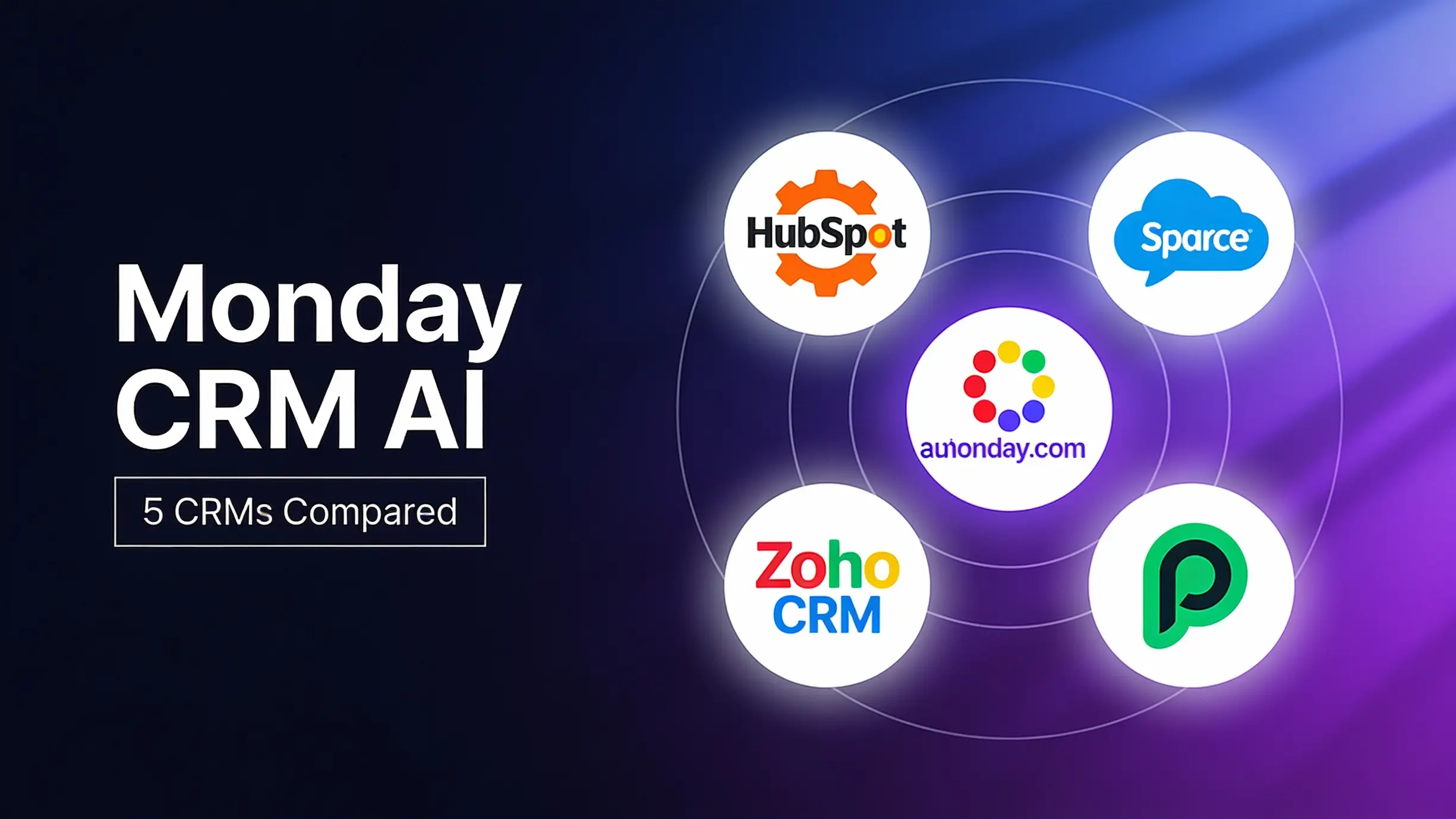
Every major CRM now claims to be AI powered, but there’s a difference between offering AI and making it useful. The question most buyers should be asking is how long it takes before your sales team is actually using AI, not watching a feature video about it, using it. That answer varies wildly depending on which platform you are using. Today I’m putting five of the biggest CRMs in the world through this single test: Monday CRM, HubSpot, Salesforce, Zoho CRM, and Pipedrive.
Number one, Monday CRM
Monday CRM is built for teams that want to start selling fast. You don’t need weeks of implementation, hours of training, or expensive consultants. Just connect your email, import your contacts, customize your sales pipeline management, and you’re ready to go, reportedly often in less than an hour. The intuitive interface makes lead management, sales forecasting, and account management simple, so your team adopts the platform quickly rather than fighting it. If you’re already using monday.com, everything should work together smoothly. If you’re starting fresh, that’s just as easy. With no code customization, you can build workflows, sales automation, and pipelines that fit the way your team works. Native integrations with email, calendars, forms, and finance tools keep all your customer data connected in one place.
AI in Monday CRM
Where Monday CRM really stands out is AI. Its AI sales CRM features are built in from day one, not bolted on, so you can start using them in minutes with no complicated setup. The built-in AI sales notetaker automatically joins sales calls, creates AI call summaries, and drafts follow-up emails. AI sales agents and AI sales assistants can qualify leads, schedule meetings, answer customer questions, and surface deals that need attention before they slip through the cracks. Since AI agents can be configured with a few simple steps, anyone on your team can put them to work. No technical expertise required. You’ll also get real-time sales dashboards and built-in sales reporting and analytics, giving you instant visibility into pipeline health, team performance, and revenue without building complex reports.
Single Source of Truth
The biggest advantage is that Monday CRM is an end-to-end platform with a single source of truth. Sales, marketing, customer success, and delivery all work from the same data. So the AI understands the full customer journey, not just one deal. It can spot risks, uncover growth opportunities, and recommend the next best action. That’s what separates native AI from an add-on.
Pricing and Verdict
There’s no free plan, but you can try the pro plan free for 14 days without a credit card. Listed pricing starts at $12 per seat per month for basic, $17 for standard, and $28 for pro. Every plan includes built-in AI capabilities and AI credits. Verdict: Monday CRM combines fast setup, strong AI, and a connected platform that can help your entire revenue team work smarter from day one.
Number two, HubSpot
HubSpot offers a free forever CRM that’s limited to two users, but includes contact management, deal tracking, and basic email tools. For a very small team just getting started or a one-person show, it’s a solid starting point. The AI story though starts with the smart CRM professional. This costs $50 per seat per month and includes the Breeze data agents, HubSpot’s built-in AI. The catch is a one-time onboarding fee for the sales and service hub that will cost you $1,500.
Breeze AI and Credits
Once you’ve paid the onboarding fee, the Breeze AI suite is highly capable, including prospecting agents for identifying leads, an AI meeting assistant that can generate call summaries, and a writing assistant for emails. However, HubSpot’s AI isn’t simply included with your plan. It comes with an AI credit system. Each action costs 10 credits and those on the professional plan start with only 3,000 HubSpot credits. That means only 300 AI actions per month unless you want to pay for additional credits. My verdict on AI availability: weeks to months, depending on budget approval, contract signoff, and onboarding. Once you clear all of that, however, Breeze is a capable platform.
Number three, Salesforce
Salesforce’s CRM comes with an AI starting at $25 per user per month and includes everything you’d expect from a professional CRM: lead, opportunity, and customer management, an email marketing suite, built-in sales flow, as well as the assistive AI feature. It is essentially a virtual assistant designed to help streamline workflows by drafting messages, generating summaries, or handling pipeline updates.
Agentforce
To get the most out of Salesforce, however, you’ll need to get involved with Agentforce, an AI powered labor force. While arguably the most powerful set of tools here, the price reflects that. The Agentforce add-on costs $125 per user per month, or if that’s too pricey, there’s the Agentforce user license, which is $5 per month, but introduces flex credits. Suffice to say, once flex credits enter the picture, costs scale quickly. Getting started with the assistive AI is easy, but Agentforce takes months of calibration to get just right. On AI availability, I’d say likely months. While Agentforce offers extreme customizability, properly training and testing each agent will be an endeavor.
Number four, Zoho CRM
Zoho CRM has competitive pricing: the standard plan at $20 per user per month, the professional plan at $35 per user per month, and the enterprise plan at $50 per user per month. The AI features scale depending on your chosen plan. The standard plan includes sales automation, process management, and deployable AI agents. These agents are fully customizable, but run entirely on AI credits.
Zia
Getting Zia, Zoho CRM’s purpose-built AI assistant, requires scaling to the enterprise plan. Zia can do a lot. Summarize messages, create workflows, generate predictions based on past behavior, and more. The exact pricing structure, however, needs you to read the fine print. Some of Zia’s basic features, like generating lead or deal summaries, do not consume credits, but more advanced features like Zia data enrichments do. In my view, the pricing structure is opaque at best.
Interface and Setup
Lastly, there’s the interface. Zoho is built for power users, and getting Zia up and running requires significant configuration first. Teams that want AI running on day one will spend time in setup before they get there. Integrations with tools outside the Zoho ecosystem also tend to need more hands-on configuration than the alternatives. Verdict on AI availability: days to weeks. Getting the basics up and running will be simple, but incorporating Zia’s predictive models will take time.
Number five, Pipedrive
Pipedrive’s main selling point is its interface. To my eye it has the cleanest pipeline view in this comparison. The entry level is affordable, too. Lite starts at $24 per seat per month, and a core experience, managing leads, generating AI powered reports, and navigating your sales feed is included and straightforward.
Gated AI
Now, the AI though is gated. Deal scoring, AI powered email summaries, and pipeline recommendations require a premium tier at $79 per user per month. Several capabilities that Outro come bundled into other platforms like lead generation tools and AI-driven email campaign oversight are separate paid add-ons regardless of tier. The gap between what you get at the entry level and what’s needed to seriously incorporate AI into your team’s CRM workflow is night and day. As for AI availability, I’d put it at days to weeks. The core functionality is solid, but advanced AI features are locked behind a steep paywall.
Recap
Comparing the Five CRMs
Pipedrive gets you started fast, but meaningful AI takes significantly more time and money. Zoho’s pricing is competitive and Zia is capable, but configuration and a complex billing system stand between you and it. HubSpot’s Breeze suite is powerful, but you’ll spend weeks clearing onboarding and weeks to months building, training, and iterating your agents. Salesforce sits in a strange position. While Agentforce is in a class all its own, it’ll take months to get running.
Where Monday CRM Lands
In this comparison, Monday CRM is the only platform that includes the full AI suite in the entry tier, leverages one AI context across the entire revenue cycle, and is already running when you show up. There are no onboarding fees, no subscription upgrades to worry about, and no months of calibration. Just a pipeline with AI built into it from day one.